Are You Falling Behind on AI? 7 Signs You're Already Late (And How to Catch Up)
5-second Summary
Most people don't realize they're falling behind on AI until it's too late. Here are 7 warning signs you're already slipping — and a concrete plan to catch up fast.
There's a quiet crisis happening right now.
While some people are using AI to write code, automate their entire workflows, and 10x their output — others are still copy-pasting into ChatGPT and calling it a day.
The gap between those two groups is growing every single week. And the worst part? Most people on the wrong side of that gap don't even know it yet.
This post isn't here to scare you. It's here to give you clarity. If any of these 7 signs sound familiar, you're probably falling behind — but the good news is, it's fixable. Fast.
1. You Still Only Use One AI Tool
If ChatGPT is the only AI tool in your life, you're leaving massive value on the table.
In 2026, the AI landscape has exploded. There are specialized tools for coding (Cursor, Claude Code), for research (Perplexity, Deep Research), for image generation (Midjourney, GPT Image), for automation (n8n, Zapier), and dozens more.

Each tool has a sweet spot. Using only one is like owning a kitchen but only ever using the microwave.
What to do: Start exploring 2-3 new AI tools this week. Pick one for your main work task, one for learning, and one for creativity. Rate them, compare them, and find what clicks.
2. You Can't Explain What a "Prompt" Actually Does
You've heard the word a thousand times. You've typed things into ChatGPT. But if someone asked you why one prompt gets better results than another, could you explain it?
Prompting isn't magic — it's a skill. And like any skill, it has levels. People who understand prompt structure, context setting, and chain-of-thought reasoning are getting dramatically better outputs than people who just type a question and hope for the best.
What to do: Learn the fundamentals of prompting. Start with two-step prompting: first ask the AI to plan its approach, then ask it to execute. You'll see an immediate difference.
3. You Haven't Built a Single AI Workflow
Using AI for one-off tasks is fine. But the real power unlock is workflows — multi-step processes where AI tools chain together to complete an entire job.

Examples of real workflows people are running right now:
Content creation: Research → outline → draft → edit → publish — all AI-assisted
Market research: Scrape competitors → summarize findings → generate strategy doc
Email management: Categorize inbox → draft responses → schedule follow-ups
If you're still doing everything manually and only asking AI for help on isolated tasks, you're working 5x harder than you need to.
What to do: Pick your most repetitive weekly task. Map out the steps. Then figure out which AI tool handles each step best. Congratulations — you just built your first workflow.
4. You Feel Overwhelmed Every Time a New AI Tool Launches
A new AI tool drops every day. Literally. If your reaction to each launch is anxiety instead of curiosity, that's a sign you don't have a system for staying current.
The people who are thriving aren't tracking every single release. They have a filter — they know what categories matter to them, what scores tools are getting, and which updates actually affect their work.
What to do: Stop doom-scrolling AI Twitter. Instead, set up a daily 5-minute routine where you check curated AI news relevant to your use cases. Focus on signal, not noise.
5. Your Job Could Be Done 50% Faster With AI — And You Know It
This is the one that stings.
Deep down, you know there are parts of your job that AI could handle. Writing reports. Analyzing data. Drafting emails. Creating presentations. Summarizing meetings.

But you haven't made the switch because it feels like a big learning curve. Here's the truth: the learning curve is much shorter than you think. Most people go from zero to productive with a new AI tool in under a week.
The cost of waiting another month is far greater than the cost of learning today.
What to do: Time yourself doing your most common work task this week. Then try doing the same task with AI assistance. Compare the times. That gap is your daily opportunity cost.
6. You Haven't Leveled Up Your AI Skills in 3+ Months
AI moves fast. If your last "AI learning moment" was months ago, your knowledge is already outdated.
Three months ago:
Claude couldn't do what it does now
Veo 3 didn't exist
Google's AI Mode wasn't live
Most coding agents were still experimental
The tools you dismissed six months ago might now be the most powerful ones available. And the techniques you learned last year might already have better alternatives.
What to do: Commit to a structured learning plan. Even 10 minutes a day compounds dramatically over 30 days. The key is consistency, not marathon sessions.
7. You Think "AI Won't Replace Me" Without Being Able to Say Why
This isn't about AI replacing you. It's about people who use AI replacing people who don't.
If your only defense is "AI can't do what I do" but you can't articulate specifically what makes your work irreplaceable, that's a red flag.

The professionals who are most secure are the ones who've integrated AI into their skillset. They're not competing against AI — they're competing as AI-augmented humans against everyone else.
What to do: Write down the 3 things you do best at work. For each one, research how AI could make you even better at it. That's your competitive moat.
So... How Do You Actually Catch Up?
If you recognized yourself in 3 or more of these signs, don't panic. The gap is real, but it's closable — and faster than you think.
Here's the honest truth about catching up with AI:
It's not about knowing everything. It's about building a system.
The people who are ahead of you aren't geniuses. They just have:
A daily habit — even 10 minutes of structured AI learning
The right tools — not all of them, just the ones that match their work
Real practice — not reading about AI, but actually using it on real tasks
A progression path — knowing what to learn next, not just what's trending
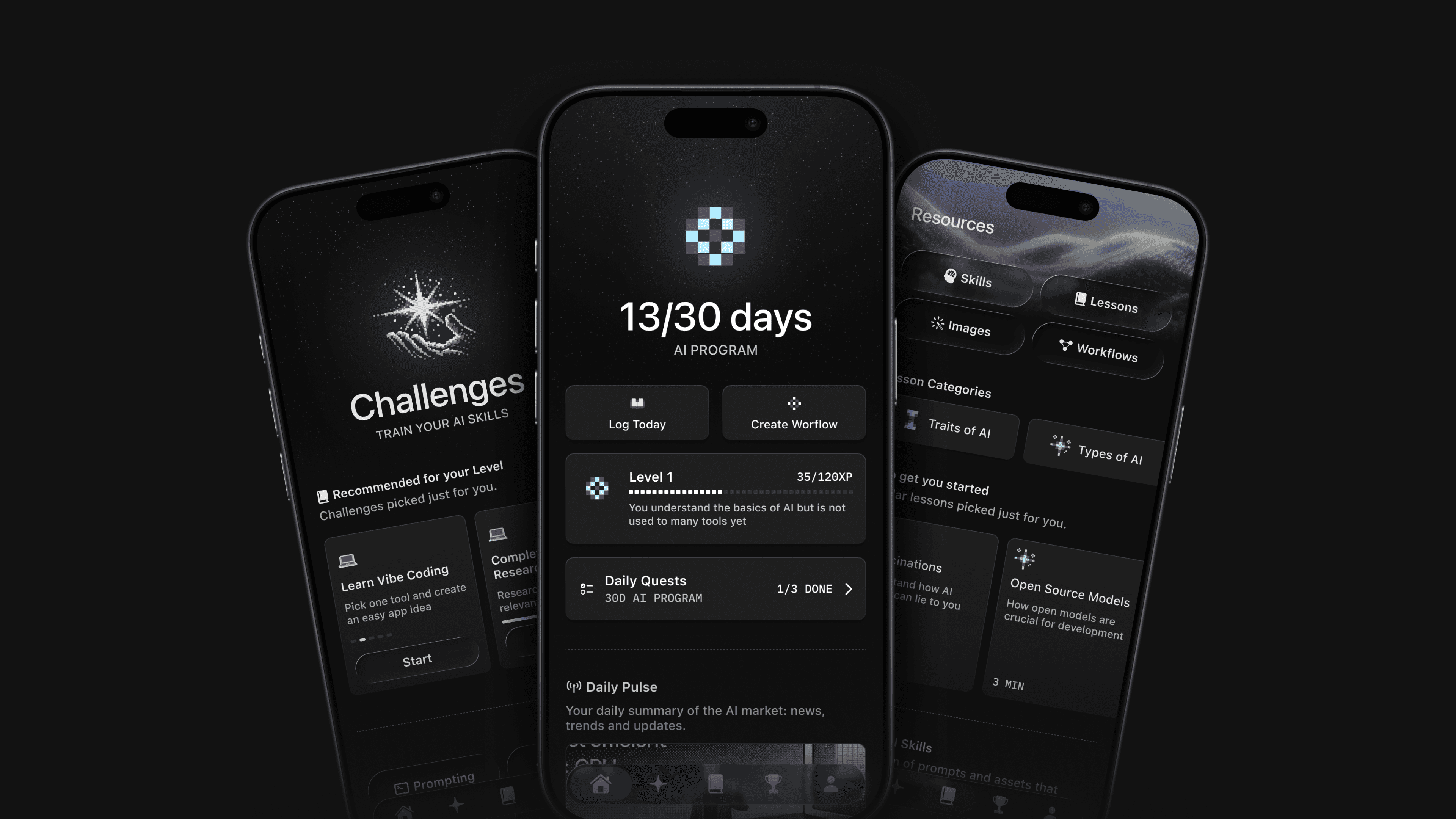
Disparity does all of this for you. It diagnoses your current AI level, builds a personalized 30-day challenge with daily tasks, tracks your streak, teaches you the right skills in order, and keeps your tool stack up to date — all in one app.
Published on
Pedro Schott
Writer at Disparity